Slavica’s Story – Gynecologic Cancer
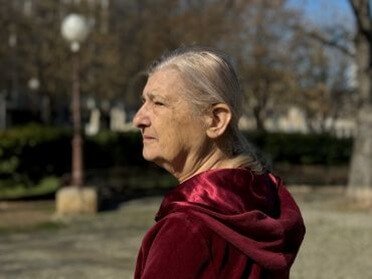 “When you feel that something is wrong, don't be silent”
Slavica Kujundžić from Popovača has gone through a long and demanding path to the right diagnosis and appropriate therapy. After almost two years of wandering around the system, it turned out that it was not possible to provide emergency radiotherapy in a timely manner at that moment, which is why a private opinion and therapy was sought at UPMC Hillman Cancer Center in Zabok.
Today, at the age of 72, she speaks openly about her experience with vulvar cancer, the importance of intuition and the great role of her family, especially her daughter, in the healing process.
Although she is retired, Slavica is active and loves to spend time in the garden, with domestic animals and family. This is not her first battle with cancer — she also had breast cancer 15 years ago.
Can you take us back to the very beginning, how it all started and when did you first feel that something was wrong?
First, I noticed a small lump, a scab on the vulva itself. I visited my gynecologist, only got creams, applied for months, but it didn't work. A swab was taken and sent for analysis and nothing was visible there because the cancer was deep in the skin.
I was also referred to the hospital in Sisak after a year of unsuccessful treatment, but even there they only recommended me a lubricating cream for the next 3 months. In that year and a half, the toad turned from the size of a pea to the size of a large coin. I went for a private examination myself and there the doctor immediately concluded that I had to undergo emergency surgery. I performed my first operation in the fall of 2023 at the Pakrac General County Hospital, where, as soon as the results arrived, I was urgently referred to the Sisters of Mercy Clinical Hospital Center in Zagreb, to the Vinogradska Hospital.
What did the first months look like when you asked for help and still didn't know what was wrong with you?
Unfortunately, my futile tours did not last for months, but for almost two years. I was confused and worried because I was using therapy, and for me this sore is only growing and spreading. I listened to my instinct and went to the gynecologist privately.
What did you think at the time when you were receiving the same therapies over and over again, and the condition was not improving? Have you suspected at some point that something more serious than they tell you is going on?
I noticed that something was wrong, I did everything as the doctors told me, and my condition was getting worse. The itching was getting stronger, and pain appeared. The moment that scab started to grow, I decided to take matters into my own hands.
How did the path to the right diagnosis go and what was the most difficult for you at the time?
Unfortunately, the journey took almost two years. The hardest thing was that the problem does not go away, but the scab spreads and grows, and the doctors you trust have been prescribing you creams for two years and do not do other diagnostic examinations. Now that I think about it, I'm not angry anymore, but I simply think that gynecologists should be educated about vulvar cancer because they obviously don't recognize it so easily. Obviously, not enough is taught about this type of cancer at the university.
Do you remember the day you found out you had cancer – where were you and how did you experience it?
I was in the Vinogradska Hospital with a wonderful surgeon who, as soon as he saw me, told me what it was about. He recommended a complex operation to prevent the disease from returning. The recovery was long and very painful. I couldn't go anywhere for weeks. You are released from the hospital with wounds that require daily dressing. My daughters hired and paid for the medical care that came to me every day for a bandage.
This is not my first encounter with cancer, so I was not too shocked. 15 years ago, I also had breast cancer.
In what way has the disease changed your attitude towards everyday things and life in general?
I can't do a lot of things anymore. Otherwise, I am active, although retired, I do not rest, I maintain the garden, I have my hens and I am constantly doing something. After the first operation, in 2024, I was able to get up again and do my usual things again: cooking, cleaning, gardening... After the second operation, nothing was the same again.
How did your daughters experience your illness and how much did you support each other?
My daughters are the best children anyone could wish for. The older one is gentle and full of encouragement, and the younger one pushes and makes me fight and not stop. They found UPMC in Zabok, arranged for me to start treatment as soon as possible. They buy me all possible dietary supplements, they pay for my entire treatment, and they don't have I don't know how much. Only because of them I am alive!
In addition to all this, my younger daughter had her own battle with cancer 3 years ago.
After the first operation, when there was no additional therapy, how did you look at your future then?
After that operation, I was fine for a year. I did not receive either chemotherapy or radiotherapy, so the oncology council decided. Because of this, I was very happy and optimistic about my recovery.
I had already undergone chemotherapy and radiotherapy once in my life, so I knew what I was missing. Now that I look at it, I don't understand that decision at all because my type of cancer is extremely aggressive and unfortunately, it came back last year.
How did you deal with the return of the disease and what was going through your head at the time?
In the spring of 2025, I began to notice that a nodule was growing on the right side of my groin. At first, I thought that I had stretched something in the garden and that was why it popped out. Soon I was scheduled for a check-up with my oncology surgeon. We did a cytopuncture and I don't know who was more shocked when the results arrived. The doctor grabbed his head in disbelief and everything was clear to me. When I heard that the disease had returned, I thought that I would not survive, that this was it, that the metastases had spread throughout my body. I was quickly ordered for another operation. The operation was difficult, and the recovery is even more difficult. Immediately after a short recovery, I was referred to an oncologist.
What led you to seek treatment at UPMC and how did you experience this new beginning?
The instruction of my oncologist at the Vinogradska Hospital was to go for radiotherapy as soon as possible, but he also expressed doubts about when it would be my turn and tried to make me a cocktail of drugs that would keep me alive until the beginning of radiation. At UPMC in Zabok, everything happened very quickly. There were no long waiting lists, and the doctors immediately knew what kind of treatment I needed. It was the beginning of October, and I got the first date for outlining on December 5th, and who knows when I would start therapy. His words were: “Madam, you need to go for radiation tomorrow!” The doctor himself was frustrated that he could not provide me with the treatment I needed.
My daughters took matters into their own hands and contacted all hospitals that perform radiotherapy, and at UPMC in Zabok we were scheduled for the first examination in a few days.
After my first arrival at UPMC, when we did the first examination and when I received a therapy recommendation, I felt that I was abandoning myself to the hands that would hold me, the eyes that would encourage me and the mouth that would push me to keep going. I felt that there might be hope for me after all.
I performed radiotherapy at UPMC Hillman, and received chemotherapy in Vinogradska. That was logistically also demanding, so my daughters and son-in-law drove me from one address to another as needed.
In the most difficult moments, where did you draw strength from for the future, what kept you “on your feet”?
Family! With children like this, you just have to keep going! And of course the granddaughter! My husband, my sister and brother, my son-in-law and close friends were by my side all the time.
When you look back on everything you've been through today, what hurts you the most, and what are you most proud of?
It hurts me that I asked for help for almost two years, without anyone recognizing what it was about or at least sending me for a diagnostic examination. It hurts me this system where a sick person needs therapy and can't get it because there aren't enough devices. I also have to say that the doctors who accompany me are wonderful people who, despite the system, do a phenomenal job, my surgeon, my two oncologists and my family doctor!
At the last check-up at the oncologist in Vinogradska, the doctor told me nicely and openly that I did not do the treatment at UPMC so that I would no longer be alive, so I can say that the experienced doctors and staff at UPMC really saved my life.
What would you like every woman to remember from your story when it comes to taking care of their own health?
Listen to your body, your intuition and even though they tell you that this is all normal, if you don't feel it, it's not okay! In all this, I learned that I can't let go of the system because if I did, I wouldn't be there anymore. Take care of yourself because life is one and it is worth fighting for!
Slavica Kujundžić's story is not only a personal testimony of her struggle with a rare form of cancer, it is also a strong reminder of how important it is to listen to your own body, seek a second opinion and not give up when the system fails. Her perseverance, her family's support, and her decision to seek additional professional help, including treatment at UPMC Hillman Cancer Center, were an important part of her journey to recovery.
This experience also highlights how limited health resources are often, but also how much individuals within the system, doctors, nurses, families, can make a difference. Slavica is alive today precisely because she did not give up.